

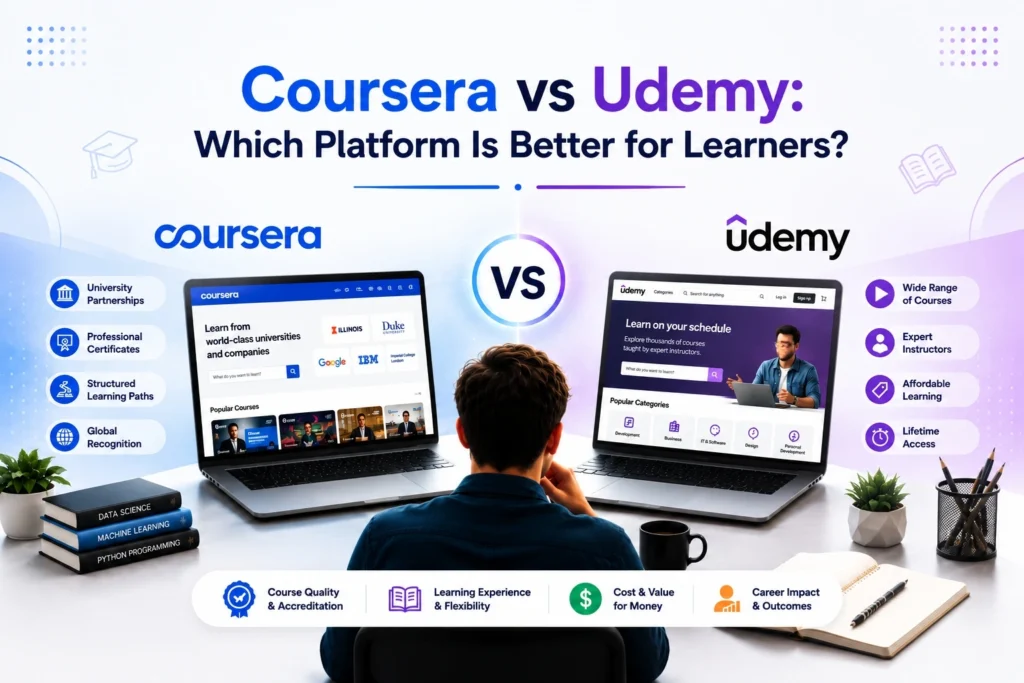
Online learning has become one of the easiest ways to build new skills, change careers, improve your resume, or learn something useful from home. Among the many online course platforms available today, Coursera and Udemy are two of the most popular names. Both platforms offer thousands of courses; learners around the world use both, and both cover high-demand topics such as artificial intelligence, data science, business, coding, marketing, design, personal development, and career skills.
But for a learner, the real question is simple: Coursera or Udemy, which one is better?
The answer depends on your goal. Coursera is usually better for structured learning, professional certificates, university-style courses, and career development. Udemy is usually better for affordable, practical, fast, and skill-specific learning. If you are serious about long-term growth, the best option is often not choosing only one. Many learners can benefit from using both Coursera and Udemy, but for different purposes.
In 2026, this comparison has become even more interesting because Coursera and Udemy are now one company, but they remain separate platforms for the time being. Coursera says that as of May 11, 2026, Coursera and Udemy are one company, but learners should not expect immediate changes to their Coursera experience. Udemy’s learner support page says the same: the two platforms remain separate for now, and there are currently no changes to the Udemy learning experience.
So, even though the companies have merged, learners still need to understand the practical differences between learning on Coursera and on Udemy.
Quick Answer: Coursera VS Udemy, Which Is Better?
If you want the shortest answer, here it is:
Choose Coursera if your goal is career growth, professional certificates, university-backed courses, structured programs, or learning from institutions such as Google, IBM, universities, and major companies.
Choose Udemy if your goal is affordable learning, quick tutorials, practical skills, software training, beginner-friendly lessons, freelancing skills, coding practice, business tools, or personal development.
Use both if you want the best of both worlds: Coursera for structured career learning and Udemy for practical hands-on improvement.
For example, if you want to become a data analyst, you might use Coursera for a full data analytics certificate and Udemy for extra Excel, SQL, Python, Tableau, or Power BI practice. If you want to learn digital marketing, you might use Coursera for a structured marketing program and Udemy for practical lessons on Google Ads, SEO tools, Canva, social media content, or email marketing.
That is the smartest way to think about Coursera vs Udemy: not as enemies, but as two different tools for different learning needs.
Coursera vs Udemy: Main Difference
The biggest difference between Coursera and Udemy is the learning style.
Coursera feels more like a university or professional training platform. Universities, companies, and institutions create many courses. Coursera offers courses, Guided Projects, Specializations, Professional Certificates, degrees, and Coursera Plus. Its course catalog includes subjects such as AI, data, business, health, computer science, and design. Coursera also highlights certificates from companies such as Google and learning programs from universities and industry partners. (Coursera)
Udemy feels more like a large online course marketplace. Individual instructors and organizations publish courses on many topics, and learners can buy individual courses or use subscription options where available. Udemy says it has more than 250,000 courses and 80 million students, with topics such as programming, marketing, data science, business, AI, and career skills. (Udemy)
This difference affects everything: course quality, teaching style, pricing, certificates, learning speed, and the platform’s usefulness for different types of learners.
Coursera is usually more structured. Udemy is usually more flexible.
Coursera is usually better for long-term learning. Udemy is usually better for solving a specific learning problem quickly.
Coursera often feels more formal. Udemy often feels more practical.
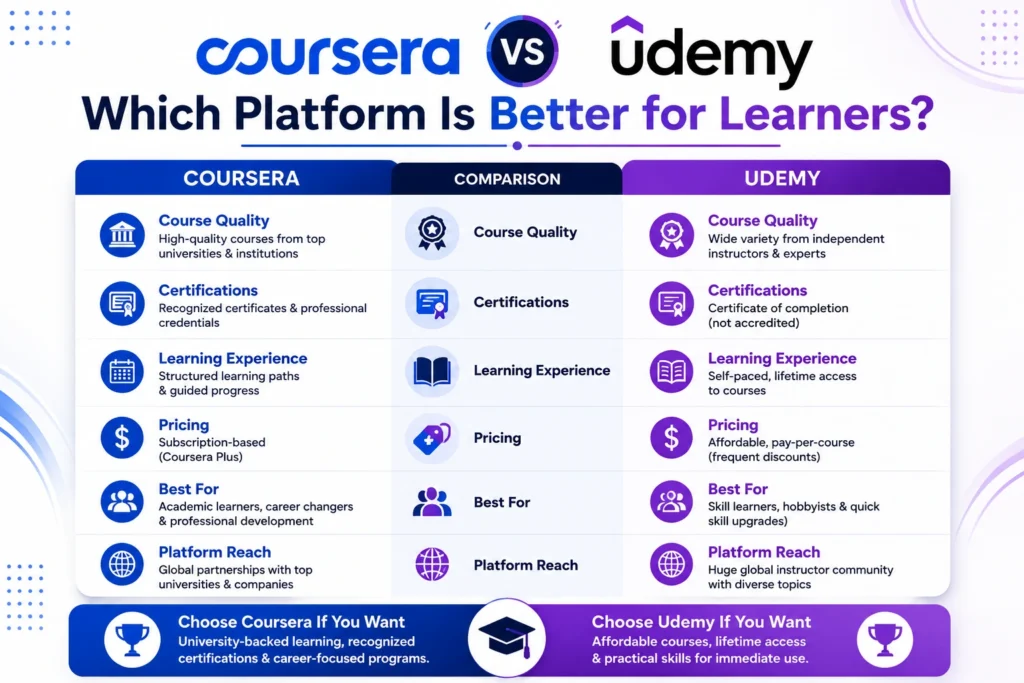
Basic Comparison Table of Coursera VS Udemy
What Is Coursera Best For?
Coursera is best for learners who want a clear path and a serious learning outcome. If your goal is to build a career skill, earn a professional certificate, prepare for a career change, or learn from universities and major companies, Coursera is a strong choice.
Coursera is especially useful for:
- Professional certificates
- Career change programs
- Data analytics
- Artificial intelligence
- Machine learning
- Cybersecurity
- Project management
- Digital marketing
- Business analytics
- Computer science
- University-style learning
- Online degrees
- Structured learning paths
For example, Google Career Certificates on Coursera are designed to help learners gain job-ready skills in areas such as UX design, project management, data analytics, and IT support. (Coursera) Coursera’s Professional Certificates are described as a series of related courses focused on hands-on experience in career-relevant skills. (Coursera Help Center)
This makes Coursera attractive for learners who want something more than a short tutorial. If you want to follow a complete path from beginner to job-ready skills, Coursera often feels more organized than Udemy.
Coursera is also better if you care about the name behind the course. A course from Google, IBM, DeepLearning.AI, Stanford, Yale, the University of Michigan, or another recognized institution may feel more valuable on a resume or LinkedIn profile than a random course from an unknown instructor.
That does not mean every Coursera course is perfect. Some courses may be slower, more academic, or more time-consuming. But if your goal is serious learning, Coursera usually gives you a stronger structure.
What Is Udemy Best For?
Udemy is best for learners who want practical, direct, affordable, and flexible learning. If you want to learn a specific skill quickly, Udemy is often easier to use.
Udemy is especially useful for:
- Learning software tools
- Coding practice
- Excel training
- Photoshop and design
- Canva
- WordPress
- Digital marketing
- Social media marketing
- Freelancing skills
- Business tools
- Productivity
- Personal development
- Photography
- Language learning
- Hobbies
- Quick beginner courses
Udemy’s strength is variety. You can search for almost any practical skill and find multiple courses from different instructors. If one teaching style does not suit you, there may be another course on the same topic.
Another advantage is that many Udemy courses are designed for beginners. The language is often simple, the lessons are practical, and instructors usually focus on “how to do this” rather than long theory. This makes Udemy very useful when you want to learn by doing.
Udemy also gives lifetime access to individually purchased marketplace courses, as long as your account remains in good standing and Udemy continues to have a license to the course. Udemy’s course pricing FAQ also says that after purchasing an individual marketplace course, learners can study at their own pace and will not be charged again for that course. (support.udemy.com)
This is one of Udemy’s biggest learner advantages. If you buy a course, you can return to it later when you need to revise the topic.
Coursera vs Udemy for Certificates
Certificates are one of the most common reasons learners compare Coursera and Udemy.
Coursera is usually better if you want a certificate that looks more professional. Many Coursera certificates come from universities, companies, or structured programs. Professional Certificates and Specializations can show that you completed a full learning path, not just one short course.
Udemy also offers certificates of completion for many paid courses. Udemy says all paid Udemy courses offer a certificate of completion, but Udemy also states that it is not an accredited institution and that certificates demonstrate skills and accomplishments rather than formal accreditation. (support.udemy.com)
This is an important difference.
A Coursera certificate may carry more weight when it comes from a known university or company. A Udemy certificate can still be useful, especially for showing personal learning, but it may not have the same recognition.
For career-focused learners, Coursera is usually stronger for certificates. For personal skill-building, Udemy certificates can still be useful, but the real value is usually the skill you learn, not the certificate itself.
Coursera vs Udemy for Beginners
Both Coursera and Udemy are good for beginners, but they support beginners in different ways.
Coursera is better for beginners who want structure. If you do not know where to start and want a complete path, Coursera can guide you step by step. For example, a beginner interested in data analytics can follow a full professional certificate instead of randomly choosing separate courses.
Udemy is better for beginners who want simplicity and speed. If you want to learn Excel basics, create a website, understand Canva, start Python, edit videos, or learn digital marketing tools, Udemy can be very beginner-friendly.
The difference is this:
Coursera tells you what path to follow. Udemy lets you choose what you want to learn.
If you are a beginner with a clear career goal, Coursera may be better. If you are a beginner who wants to explore different topics, Udemy may be easier and cheaper.
Coursera vs Udemy for Career Growth
For career growth, Coursera is usually the stronger platform.
Coursera is built around career skills, credentials, university learning, and professional programs. It is useful when you want to show employers that you completed a structured course or certificate from a known provider. Coursera also reported 205 million cumulative registered learners after adding 7.6 million new registered learners in the first quarter of 2026, which shows the platform’s large global reach. (Coursera Investor Relations)
Coursera is especially useful for career paths such as:
- Data analyst
- Project manager
- UX designer
- Digital marketer
- Cybersecurity analyst
- IT support specialist
- Business analyst
- AI specialist
- Software developer
- Cloud computing learner
Udemy can also help your career, but usually in a different way. Udemy is excellent for adding practical skills to your existing career. For example, if you are already a marketer, Udemy can help you learn Google Ads, SEO tools, copywriting, email marketing, or Canva. If you are already in business, Udemy can help you learn Excel, PowerPoint, leadership, sales, or productivity tools.
So, for career growth:
Use Coursera to build your main career path. Use Udemy to add practical skills around that path.
That combination works very well for many learners.
Coursera vs Udemy for Coding and Technology
For coding and technology, both platforms are useful.
Coursera is better if you want a deeper computer science or data science foundation. It is good for machine learning, data science, AI, algorithms, cybersecurity, cloud computing, and professional certificates.
Udemy is better if you want to learn a specific programming language or framework quickly. For example, Udemy can be very useful for Python, JavaScript, React, Node.js, WordPress, Flutter, Excel VBA, SQL, Power BI, and web development projects.
If you want to become a software developer from zero, Coursera can give you structure, but Udemy can give you more hands-on tutorials. Many learners use Coursera for concepts and Udemy for practice projects.
A smart coding learner might do this:
Start with a Coursera programming or computer science course
Use Udemy to build real projects
Return to Coursera for advanced certificates
Use Udemy again for specific tools and frameworks
This approach gives you both theory and practice.
Coursera vs Udemy for AI Courses
Artificial intelligence is one of the biggest learning topics in 2026. Both Coursera and Udemy offer AI courses, but again, the difference is in learning style.
Coursera is better for AI learners who want structured programs from well-known educators or companies. Coursera’s catalog includes popular AI-related programs, including Google AI courses, Google AI Essentials, DeepLearning.AI programs, machine learning, and other AI learning paths. (Coursera)
Udemy is better for learners who want practical AI tool training. If you want to learn ChatGPT prompts, AI tools for content creation, AI for business, AI image generation, automation tools, or AI productivity workflows, Udemy often has practical, fast-moving courses.
AI changes quickly. That makes Udemy useful because instructors can publish practical courses around new tools and trends. Coursera is useful when you want a stronger foundation and more trusted structure.
For AI learning, the best choice is often both:
Use Coursera for AI fundamentals
Use Udemy for AI tools and daily practice
Coursera vs Udemy for Business and Marketing
For business and marketing, Udemy is often more practical, while Coursera is often more strategic.
Coursera is useful for structured business topics such as leadership, business analytics, project management, finance, entrepreneurship, digital transformation, and marketing strategy. If you want a certificate or a more formal learning path, Coursera is a good option.
Udemy is useful for practical business tasks such as creating ads, building websites, running email campaigns, using Canva, editing videos, writing copy, building sales funnels, learning Excel, creating presentations, or managing social media.
For example, a learner who wants to understand digital marketing as a career may prefer Coursera. A learner who wants to run Facebook Ads next week may prefer Udemy.
Both are useful, but the best platform depends on urgency.
If you want a career path, choose Coursera.
If you want a practical tool, choose Udemy.
Coursera vs Udemy Pricing
Pricing can change depending on country, course type, subscription, discounts, and platform updates, so learners should always check the latest price on the official website before buying.
In general, Udemy is often cheaper for individual courses, especially during promotions. Many learners like Udemy because they can buy one course and keep access to it. This is helpful if you want to learn at your own pace without paying every month.
Coursera often uses subscriptions for many courses and programs. Coursera Plus gives access to many courses, projects, Specializations, and Professional Certificates. Coursera says Coursera Plus provides unlimited access to over 90% of courses, Projects, Specializations, and Professional Certificates on the platform. (Coursera)
So, which is better for pricing?
Udemy may be better if you want to buy one course at a low price.
Coursera Plus may be better if you plan to complete multiple courses or certificates in one year.
Coursera individual programs may be worth it if the certificate is important for your career.
Udemy may be better if your budget is small and your goal is practical learning.
The best pricing decision depends on how many courses you realistically plan to complete.
Course Quality: Which Platform Has Better Courses?
Course quality depends on the course, instructor, topic, and your learning style.
Coursera usually has stronger quality control because many courses are created by universities and companies. The content is often more structured, professional, and consistent. This is useful for learners who want a reliable academic or career-focused experience.
Udemy quality can vary more because it is a marketplace. Some Udemy courses are excellent, while others may be outdated, too basic, or poorly explained. The advantage is that Udemy gives you many choices. You can check ratings, reviews, course previews, instructor profiles, update dates, curriculum, and student feedback before buying.
Before choosing any Udemy course, check:
- Course rating
- Number of reviews
- Last updated date
- Instructor experience
- Course length
- Preview videos
- Student comments
- Whether the course includes projects
- Whether the content matches your level
Before choosing any Coursera course, check:
- Course provider
- Certificate type
- Time required
- Syllabus
- Reviews
- Difficulty level
- Whether it is part of a larger program
- Whether the certificate matters for your goal
Neither platform is perfect. Good learners compare the course, not only the platform.
Should You Continue Both Coursera and Udemy?
Yes, if you are already using both and learning from both, it makes sense to continue both — but with a clear plan.
Do not continue both just because you are collecting courses. Continue both only if each platform has a purpose in your learning journey.
A good approach is:
Use Coursera for your main learning path.
For example, choose a professional certificate, specialization, or structured course related to your career goal.
Use Udemy for support skills.
For example, buy practical courses that help you use tools, build projects, or practice what you are learning.
Let’s say your goal is to become a data analyst. Your plan could look like this:
Coursera: Data Analytics Professional Certificate
Udemy: Excel course
Udemy: SQL course
Udemy: Power BI or Tableau course
Coursera: Advanced Data Analytics or Machine Learning course
This is much better than randomly buying many courses and not finishing them.
The real problem for most learners is not choosing Coursera or Udemy. The real problem is starting too many courses and completing none. A focused learning plan is more important than the platform.
When Coursera Is the Better Choice
Coursera is better when:
- You want a recognized certificate
- You want structured learning
- You are preparing for a career change
- You want university or company-backed courses
- You want professional skills
- You want a guided path
- You want to learn deeply
- You want to add credentials to your resume or LinkedIn profile
- You are willing to spend more time on a course
- You prefer a formal learning environment
Coursera is also better if you are unsure how to organize your learning. Instead of choosing random courses, you can follow a full program.
When Udemy Is the Better Choice
Udemy is better when:
- You want affordable courses
- You want to learn quickly
- You want practical tutorials
- You want lifetime access to a purchased course
- You want to learn one specific skill
- You want to compare many instructors
- You want beginner-friendly explanations
- You want software training
- You want freelancing or business skills
- You want flexible, self-paced learning
Udemy is also better if you want to solve a specific problem. For example, “How do I create a WordPress website?” or “How do I use Excel pivot tables?” or “How do I edit videos in Premiere Pro?”
Common Mistakes Learners Make
One common mistake is thinking a certificate alone will change your career. A certificate can help, but skills, projects, practice, and confidence matter more.
Another mistake is buying too many Udemy courses during discounts and never completing them. Cheap courses are only valuable if you actually study them.
A third mistake is starting a long Coursera program without enough time. If a certificate requires several months of study, you need a realistic schedule.
A fourth mistake is choosing based only on platform popularity. The best course for you depends on your goal, your level, your budget, and your preferred learning style.
A fifth mistake is not building projects. Whether you learn on Coursera or Udemy, you should create something: a portfolio, website, dashboard, case study, project file, design, report, or GitHub repository.
Summary: Coursera or Udemy?
Coursera is better for learners who want structured education, professional certificates, university-backed learning, and career growth.
Udemy is better for learners who want affordable, flexible, practical, and skill-specific courses.
But for many learners, the best answer is not Coursera or Udemy. The best answer is Coursera and Udemy together.
Use Coursera when you need structure. Use Udemy when you need practice. Use Coursera when you want a career path. Use Udemy when you want to learn a tool. Use Coursera when you want a certificate with stronger recognition. Use Udemy when you want fast, affordable learning.
In 2026, Coursera and Udemy are now one company, but they are still separate platforms for learners. That means you can continue smartly using both. Instead of asking which platform is better overall, ask a better question:
Which platform is better for what I want to learn right now?
→ That question will lead you to the right choice.
FAQs About Coursera vs Udemy for Learners
Which is better, Coursera or Udemy?
→ Coursera is better for structured learning, professional certificates, university-backed courses, and career growth. Udemy is better for affordable, practical, beginner-friendly courses and learning specific skills quickly.
Should I continue both Coursera and Udemy?
→ Yes, you can continue both if you use them for different purposes. Use Coursera for your main career learning path and Udemy for practical skills, tools, and extra practice.
Is Coursera better than Udemy for certificates?
→ Yes, Coursera is usually better for certificates because universities, companies, and recognized institutions offer many courses and programs. Udemy certificates can show course completion, but Udemy states that it is not an accredited institution. (support.udemy.com)
Is Udemy better than Coursera for beginners?
→ Udemy can be better for beginners who want simple, practical, low-cost lessons. Coursera can be better for beginners who want a structured path and long-term career direction.
Which platform is better for career growth?
→ Coursera is usually better for career growth because it offers Professional Certificates, Specializations, and university-style learning paths. Udemy helps add practical skills to your career.
Which platform is better for coding?
→ Both are useful. Coursera is better for computer science foundations and structured learning. Udemy is better for practical coding tutorials, projects, frameworks, and specific programming tools.
Which platform is better for AI courses?
→ Coursera is better for AI fundamentals and structured AI programs. Udemy is better for practical AI tools, prompt engineering, automation, and fast-moving AI software tutorials.
Which platform is cheaper?
→ Udemy is often cheaper for individual courses, especially during promotions. Coursera may be better value if you plan to complete multiple courses or certificates through Coursera Plus.
Do Udemy courses give lifetime access?
→ Udemy says learners retain lifetime access to previously purchased courses as long as the account is in good standing and Udemy continues to have a license to the course. (support.udemy.com)
Are Coursera and Udemy now the same platform?
→ No. Coursera and Udemy are now one company as of May 11, 2026, but they remain separate platforms for the time being, and both companies say there are currently no immediate changes to the learner experience. (Coursera Blog)
What is the best way to use both platforms?
→ The best way is to use Coursera for structured learning and Udemy for practical support skills. For example, take a Coursera certificate for data analytics and use Udemy courses to practice Excel, SQL, Python, or Power BI.
Which platform should I choose if I only have time for one?
→ Choose Coursera if your goal is career growth, certificates, or structured learning. Choose Udemy if your goal is to quickly learn a specific skill, tool, or software at a lower cost.